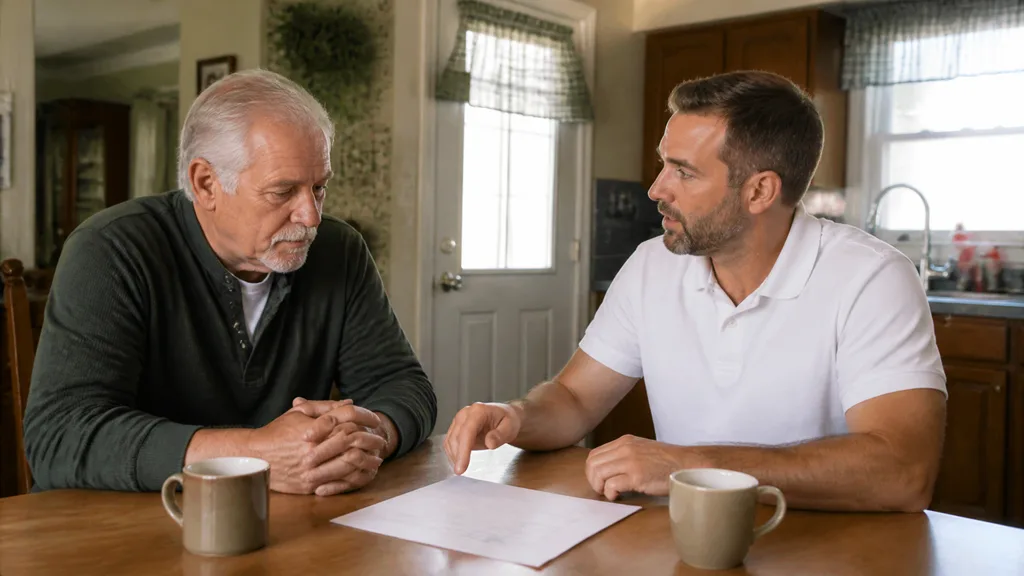



Mary's family faced this when her mother-in-law, 85, moved into a nursing home. Mary's husband held his mother's power of attorney, so the authority to sell was his. For how the house fits into paying for care, see our page on selling a house when health changes the plan.
This is general information about Missouri law, not legal advice. When your case turns on the wording of your document, have a Missouri real estate or elder law attorney read it.
Can you sell someone else's house in Missouri with a power of attorney?
Yes, if the power covers real estate, it is in effect, and the owner is alive. The owner who signed it is called the principal.
Start with scope. A power granting general powers for "all lawful subjects and purposes" reaches every matter the owner could handle through an agent, including signing deeds and contracts (RSMo 404.710). A limited power works only for the subjects it lists, so real estate has to be one of them. A health care power of attorney is for medical decisions, so check that yours also covers property.
Then check durability, which decides whether the power still works once your parent can no longer decide. A Missouri power is durable if it is titled "Durable Power of Attorney," says in substance that the authority survives disability or incapacity, and is signed, dated and notarized the way a deed is (RSMo 404.705). A power signed in another state also counts if it was durable under that state's law (RSMo 404.703). A power that is not durable is suspended while your parent cannot evaluate information or communicate decisions (RSMo 404.714).
As the agent, you sign in a way that shows your role, and you keep your parent's money separate from your own (RSMo 404.712). You also owe your parent a fiduciary duty: act in their best interest, stay in touch, follow their instructions where you can, and avoid self-dealing (RSMo 404.714).
If your parent can still decide and wants to, they can sign the sale papers themselves.
What does the title company need to see before it accepts the POA?
Plan on handing over the signed original early, with your ID. The title company checks that the power covers the sale and is still in effect, and it may ask you to sign an affidavit.
Missouri counts a title insurance company as a "third person" that deals with an agent (RSMo 404.703). Acting in good faith, it can rely on the power without investigating most of the background. It can also rely on your sworn statement about facts such as whether your parent is alive and whether your authority still stands (RSMo 404.719).
Expect the closer to look for:
- The durable wording and the notary's acknowledgment, if your parent can no longer decide.
- Authority over real estate, through a general grant or by naming it.
- Specimens of your signature, and in some cases an indemnity agreement or a bond against forgery (RSMo 404.719).
- The proof the document calls for, if it only takes effect on a future event such as your parent's incapacity (RSMo 404.714).
Each title company sets its own requirements, so ask in the first week. In our out-of-state case study, the seller held power of attorney for a minor child, and TruTitle worked with the seller's own attorney.

Does the POA have to be recorded with the county recorder?
For a sale, yes. Missouri requires a power to convey real estate to be acknowledged and recorded the same way a deed is (RSMo 442.360), with the recorder where the house sits.
A durable power does not need recording to be valid for most purposes, and the statute names real estate as the exception (RSMo 404.705). Once recorded, a power is not treated as revoked until the revocation is recorded in the same office (RSMo 442.370).
The City of St. Louis and St. Louis County are separate jurisdictions, each with its own recorder:
- St. Louis County: the Recorder of Deeds at 41 S. Central Ave in Clayton takes the original notarized document by mail or drop-off and returns it within a week of recording.
- City of St. Louis: the Recorder of Deeds is in City Hall, Room 126, at 1200 Market St. Its rules include a 3-inch blank margin at the top of the first page, a printed name under each signature and a notary seal in black ink.
The title company can record the power along with the deed. Ask whether it will, and whether it wants the original or a certified copy.
What changes if the owner has dementia or has already died?
Dementia changes little if the power is durable: you keep the authority to sign. Death ends the power, and the house then passes by its deed or through probate.
Under a durable power, a third person can deal with you even knowing your parent is incapacitated (RSMo 404.719). A new power is only good if your parent had the legal capacity to sign it (RSMo 404.719), which is a question for a Missouri attorney.
Without a usable power, the probate division can step in. It can appoint a guardian for the care of the person and a conservator for the estate, meaning the money and property (RSMo 475.010). A conservator needs a court order to sell real estate (RSMo 475.200).
Missouri lists the principal's death as an event that terminates the power (RSMo 404.717). The same section protects an agent who acts in good faith without knowing of the death, but do not plan a closing around that. After a death, the agent answers to the estate's personal representative and hands over the parent's property and records (RSMo 404.714).
Then the deed decides the route. A beneficiary deed recorded before the owner's death transfers the house to the named beneficiary at death (RSMo 461.025). A house in your parent's name alone usually goes through probate, where a personal representative, meaning an executor or administrator, handles it (RSMo 472.010). Our page on selling an inherited house covers that route.
How does Medicaid (MO HealthNet) affect selling a parent's house?
It can affect eligibility, put a lien on the house, and create a claim against the estate after death. Ask before you sign a contract.
- Eligibility. MO HealthNet nursing home coverage has set limits on the income and resources a person can have. A sale turns the house into money in your parent's name, which can change that picture. The Family Support Division answers questions at 855-373-4636.
- The TEFRA lien. MO HealthNet places a lien on property owned by participants 55 and older receiving long-term care in a nursing facility. It is paid when the property is sold or the participant dies, and removed if they return home. MO HealthNet does not take ownership of the house.
- Estate recovery. After a participant dies, MO HealthNet seeks repayment from the estate, which can include a home. Missouri makes that a debt of the estate, and the probate estate cannot close without a release from the MO HealthNet Division unless the division waives it (RSMo 473.398). MO HealthNet does not seek repayment while a spouse, a child under 21, or a blind or disabled child is living.
A mortgage or lien is paid from the sale at closing. Mary's mother-in-law's house still owed about $41,000, and our team coordinated that payoff. These rules turn on details, so ask a Missouri elder law attorney how a sale fits your parent's coverage.
How long does a POA sale take, start to finish?
About as long as any sale, plus the time the title company needs to review the power. On our side: "We can make an offer within 24 hours. We can close in as little as 7 days when the title is clear; 30 to 60 days is typical." The out-of-state sale in our case study closed in about 30 days, with a mobile notary for the signing.
The usual order:
- Read the document's scope, durable wording and any start condition.
- Send a copy to the title company before you agree to a closing date.
- Get the offer and sign the contract as agent.
- The title company searches the title and lines up any payoff.
- Sign the closing papers before a notary, in St. Louis or where you live.
Our offer starts from what the house would sell for, then subtracts a realistic repair budget and the costs we take on, and you see each line, as how we buy houses explains. Mary's family worked from a range of about $47,000 to $62,000 on a house with foundation concerns. A dedicated transaction coordinator handles each sale. There is no agent or commission, and no closing costs are passed to you.
Our FAQ is plain about the price: "We pay fair prices, but not always full market value. For houses needing repairs, we calculate fair prices by subtracting repair costs." As the agent, you owe your parent your best judgment. If the house is in good shape and there is time to list it, a listing may bring more, so compare our number with an agent's opinion.
Frequently asked questions
Can I sign at closing if I live out of state?
Yes. Missouri accepts an acknowledgment taken outside the state by any notary public in the United States (RSMo 442.150), so you can sign before a notary where you live. The out-of-state seller in our case study closed with a mobile notary. Ask the title company early how it handles signings from another state, since each company sets its own process.
Does a durable POA cover real estate automatically?
No. "Durable" describes how long the power lasts, not what it covers. A power granting general powers for all lawful subjects and purposes covers real estate, including signing a deed (RSMo 404.710). A limited power covers only what it lists. Some acts need express words in any power, such as making gifts or changing beneficiary designations (RSMo 404.710).
Can I sell my parent's house to myself under a POA?
Sometimes, but it puts you on both sides of the deal. Missouri holds an agent to a trustee's standard: act in your parent's best interest and avoid self-dealing (RSMo 404.714). A price below market value can look like a gift, and a power must expressly authorize gifts (RSMo 404.710). The probate court can approve a transaction it finds beneficial to your parent (RSMo 404.727). Have a Missouri attorney review the plan first.
What if my siblings object?
The agent answers to your parent, not the siblings. If your parent can still give instructions, the agent must communicate with them and follow those instructions where possible (RSMo 404.714). If your parent is incapacitated, an adult family member can ask the probate court for an accounting, and the court can direct, limit or remove the agent (RSMo 404.727). Share the offer and your reasons in writing, and call a Missouri attorney if anyone mentions court.
Do we need court approval?
Usually not, when a valid power covers the sale. Missouri gives an agent with general powers the same rights as the principal acting in person (RSMo 404.710), and a title company can rely on the power in good faith (RSMo 404.719). Court comes in when there is no usable power: the probate division may appoint a conservator, who needs a court order to sell real estate (RSMo 475.200).
Where does the sale money go?
To your parent. The mortgage and any liens are paid at closing, and the rest belongs to your parent, held in their name or in yours as their agent, separate from your own money (RSMo 404.712). If your parent dies, the agent turns over the parent's property and records to the personal representative (RSMo 404.714). If your parent is on MO HealthNet, call the Family Support Division before you move the money.
When you are ready to talk
If you hold a power of attorney for a parent, we can look at the house and make an offer for you to compare with your other options. Our page on selling a house for health reasons covers the care side. You can send us a message or call (314) 334-1481.
Sources
- Missouri Revisor of Statutes: RSMo 404.703
- Missouri Revisor of Statutes: RSMo 404.705
- Missouri Revisor of Statutes: RSMo 404.710
- Missouri Revisor of Statutes: RSMo 404.712
- Missouri Revisor of Statutes: RSMo 404.714
- Missouri Revisor of Statutes: RSMo 404.717
- Missouri Revisor of Statutes: RSMo 404.719
- Missouri Revisor of Statutes: RSMo 404.727
- Missouri Revisor of Statutes: RSMo 442.150
- Missouri Revisor of Statutes: RSMo 442.360
- Missouri Revisor of Statutes: RSMo 442.370
- Missouri Revisor of Statutes: RSMo 461.025
- Missouri Revisor of Statutes: RSMo 472.010
- Missouri Revisor of Statutes: RSMo 473.398
- Missouri Revisor of Statutes: RSMo 475.010
- Missouri Revisor of Statutes: RSMo 475.200
- Missouri Courts, 13th Circuit: Guardianship and Conservatorship, Adult
- 22nd Judicial Circuit, City of St. Louis: Probate Division
- St. Louis County Recorder of Deeds: How to record a deed
- City of St. Louis Recorder of Deeds: Land Records Document Requirements
- Missouri Department of Social Services: MO HealthNet Cost Recovery
- Missouri Department of Social Services: MO HealthNet Nursing Home Coverage
- Missouri Legal Services: Power of Attorney in Missouri