



An eviction runs on the court's calendar. A buyout runs on the move-out date you both agree to, but only if the tenant keeps the deal.
If what you really want is to sell the house, you may not need either. We buy with tenants in place. No eviction required. This is general information about Missouri's rules, not legal advice. Where your case turns on details, talk to a Missouri real estate attorney.
What is cash for keys, and is it legal in Missouri?
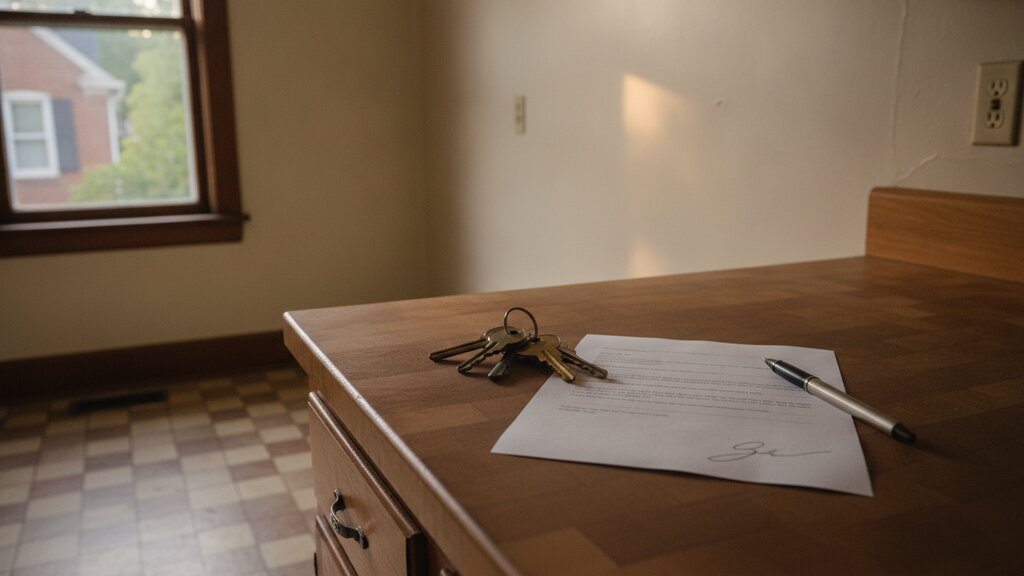
Cash for keys is a move-out agreement. The tenant leaves by a set date, returns every key and leaves the house in an agreed condition, and the landlord pays an agreed amount.
The practice spread with foreclosures, where lenders paid occupants to leave instead of waiting on an eviction. A California Department of Real Estate consumer alert describes what owners usually ask for: move out within a set number of days, leave the house broom-swept, clear the debris, leave the fixtures in place, and turn over the keys and garage door openers.
In Missouri it is an ordinary agreement between landlord and tenant. Legal Services of Eastern Missouri (LSEM), the legal aid office for St. Louis City and County, lists "moving out by a certain date in exchange for lower or no rent due" as one way to settle an eviction case.
What a buyout can't do is let you force the issue. Under RSMo 441.233, a landlord who removes a tenant or their belongings without a court order, removes the doors or locks, or willfully cuts off utilities is guilty of forcible entry and detainer. The Attorney General's guide puts it plainly: a landlord may not evict a tenant without a court order.
How do St. Louis landlords decide what to offer?
A useful way to set the amount is to work backward from two numbers: what the court route would cost you, and what moving would cost the tenant. A workable offer sits somewhere between them.
We haven't found a published, sourced figure for what St. Louis landlords pay for cash for keys, so we won't quote one. The California alert says the amount depends on the property's value and condition, the owner's plans for it, and how much time the tenant needs.
On your side, count the months a tenant who isn't paying could stay while a case moves through court, the filing and service fees, and an attorney if you hire one. If a sale or a new lease is waiting on an empty house, each month costs more.
On the tenant's side, the California alert lists security and utility deposits, moving expenses, sometimes temporary housing, and a bonus for an early date. Forgiving back rent matters to a tenant who can't pay it. So does their record: an eviction case shows on Missouri's public Case.net site, and LSEM's tenant toolkit says landlords "almost always look up eviction records."
The security deposit doesn't count toward the offer. It's the tenant's money, held under RSMo 535.300 with its own deadline and rules, so keep it as a separate line.
How does a cash-for-keys deal compare with an eviction in Missouri?
An eviction ends with a court order the sheriff can enforce, but it runs on the court's schedule. A buyout can end on a date you choose together, but it rests on the tenant's word.
The court route depends on why you want the tenant out:

- For unpaid rent, you demand the rent, and if it isn't paid you can file a rent and possession case in the county where the house sits, with no one-month notice first. The summons sets a court date no more than 21 business days after it issues, unless you agree in writing to a later one.
- To end a month-to-month tenancy, you give written notice ending it on a rent-paying date at least one month after the tenant receives it, under RSMo 441.060.
- For a broken lease condition, RSMo 441.040 calls for ten days' notice to vacate.
- If the tenant stays past the end, the case is an unlawful detainer, filed after the date in your written demand has passed.
A tenant who pays all the rent owed plus court costs can stop a rent and possession case. Ten-day windows follow a judgment, covered in the FAQ. City of St. Louis cases are heard downtown on North Tucker, and St. Louis County cases go to Clayton.
Cash for keys against eviction, side by side:
- Who decides: you and the tenant, against a judge.
- Timing: the date you agree on, against the court calendar. No Missouri statute sets a total length.
- Cost: the payment and any rent you forgive, against court costs, any lawyer and rent you may never collect.
- Certainty: a private promise, against a judgment the sheriff enforces.
- The tenant's record: no case filed, against a public one.
What should the written agreement say?
Put every term of the cash-for-keys agreement on paper, signed and dated by you and every adult on the lease. The goal is to leave nothing either side could remember differently later.
- The parties and the address: every tenant on the lease and every owner of the house, such as siblings who inherited it.
- The move-out date and time: a specific day and hour, not "end of the month."
- The condition: broom-swept, all belongings and trash out, appliances and fixtures left in place.
- The keys: every house key, garage door opener and mailbox key, with a signed key receipt. LSEM's toolkit includes a sample.
- The walkthrough: a final walkthrough at the handover. For the deposit inspection, Missouri law requires reasonable written notice of the date and time, and the tenant has the right to be there.
- The payment: the amount, the form, such as a cashier's check, and when it's paid.
- The rent: what is owed through the move-out date and what, if anything, is forgiven.
- The deposit: that it's handled separately under the deposit statute.
- Any open case: whether you'll dismiss it once the tenant leaves, or file the deal as a consent judgment.
What if the tenant takes the money and does not leave?
Then you're back on the court route, and you may be out the money as well. The best protection is to pay at the handover, not before.
A signed agreement doesn't let you change the locks or set belongings on the curb, because RSMo 441.233 still applies. If the date passes, the usual next step is a written demand for possession and an unlawful detainer case. Whether your agreement ended the tenancy on that date shapes the case, so ask a Missouri real estate attorney.
Two steps lower the risk. First, pay at the handover. Walk through the empty house, collect the keys, sign the key receipt, then pay. The California alert tells tenants never to hand over keys until the money is delivered, so plan for both to change hands at one visit.
Second, if a case is already filed, consider a consent judgment. LSEM explains that a consent judgment becomes a court order. If the tenant breaks it, the landlord can ask the sheriff to enforce it, and the tenant can't appeal. LSEM also tells tenants not to sign one they don't understand, so expect the tenant to read it closely.
Can you sell the house with the tenant still in it instead?
Often, yes. You can skip both the buyout and the court case if the buyer takes the house with the tenant in it.
LSEM's toolkit says the new owner usually must follow the lease until it ends and return the security deposit when the tenant moves. The Attorney General's guide says landlords should tell tenants in writing when ownership transfers.
We buy with tenants in place. No eviction required. Our FAQ says we handle tenant-occupied properties regularly, and you don't have to manage that process on your own. Our page on selling a house with tenants in St. Louis covers what landlords usually ask first.
The tradeoff is price. We pay fair prices, but not always full market value, and for houses needing repairs we subtract the repair costs. The offer starts from what the house would sell for, then takes out a realistic repair budget and the costs we take on, and you see each line. How we buy houses walks through it. No agent, no commission, no closing costs passed to you.
For older St. Louis rentals, our answer on condition is short: "Any condition. Deferred maintenance, original systems, anything." Our page on selling a house as-is explains how condition shapes the number.
A buyout is the better path in some cases. If the house is in good shape and you plan to list it for a buyer who will live there, that buyer needs it empty, and a listing may leave you more even after you pay for the keys. The same goes if you plan to move in or rent it again. If you inherited the rental from a parent, see selling an inherited house for the estate side.
Frequently asked questions
Do I have to offer cash for keys?
No. A buyout is a voluntary contract, and the tenant can say no. Missouri's eviction route runs through notice, a court case and the sheriff, and no step in it depends on an offer. You can choose one instead of a case, or alongside one, when the numbers make sense. Either way, the rules against lockouts and utility shutoffs still apply.
When should I pay the tenant?
At the handover. Walk through the empty house with the tenant, check it against the condition the agreement lists, collect every key and sign a key receipt. Then pay, in the form the agreement names. If the tenant needs part of the money first to rent the next place, pay a small amount at signing and the rest at the handover. Keep the first payment to an amount you could lose without regret.
Can I deduct damage from the payment?
Only if the agreement makes the payment depend on the house's condition, so spell that standard out. Damage is usually handled through the deposit. Under RSMo 535.300, you can withhold only what's reasonably needed for unpaid rent, for restoring the unit to its condition at move-in apart from ordinary wear and tear, and for losses from inadequate notice. You must send an itemized list within 30 days. Withholding any of it wrongly can cost twice the amount wrongly withheld.
Does a cash-for-keys deal need a lawyer?
Not every deal does, but some should. Bring in a Missouri real estate attorney when a case is already filed, the rent owed is in dispute, several heirs own the house, or you want a consent judgment. The California Department of Real Estate advises having a trusted attorney review any cash-for-keys agreement. Tenants can get free help from Legal Services of Eastern Missouri at 314.534.4200, and a deal both sides understand is easier to keep.
How long does a Missouri eviction take?
No Missouri statute sets a total. Notice comes first: a rent demand, ten days for a broken lease condition, or one month for a month-to-month tenancy. In a rent and possession case, the court date is no more than 21 business days after the summons issues, unless the landlord agrees to later. The first date is often a docket call, and continuances add time. After a judgment, ten more days pass before the sheriff can act.
Does the security deposit still have to be returned?
Yes. Within 30 days after the tenancy ends, Missouri law requires the landlord to return the full deposit or send an itemized list of damages with the balance. Mailing it to the tenant's last known address counts. Deductions are limited to unpaid rent, damage beyond ordinary wear and tear, and losses from inadequate notice. If you sell with the tenant in place, LSEM says the new owner usually must return the deposit when the tenant moves.
Talk it through, on your timeline
If you'd rather sell the house than manage a buyout, read how we buy houses with tenants in place. You can contact us or call (314) 334-1481 and tell us about the house and the lease. No pressure, and no rush.
Sources
- Missouri Revisor of Statutes: RSMo 441.060, ending a month-to-month tenancy
- Missouri Revisor of Statutes: RSMo 441.040, ten days' notice to vacate
- Missouri Revisor of Statutes: RSMo 441.233, unlawful removal and utility shutoffs
- Missouri Revisor of Statutes: RSMo 535.020, filing a rent and possession case
- Missouri Revisor of Statutes: RSMo 535.030, summons, court date and the ten days after judgment
- Missouri Revisor of Statutes: RSMo 535.160, paying rent and costs to stop the case
- Missouri Revisor of Statutes: RSMo 534.030, unlawful detainer
- Missouri Revisor of Statutes: RSMo 534.350, execution for possession
- Missouri Revisor of Statutes: RSMo 535.300, security deposits
- Missouri Attorney General: Missouri's Landlord-Tenant Law (revised September 2025)
- Legal Services of Eastern Missouri: Housing Law, What is Lawful Eviction
- Legal Services of Eastern Missouri: Tenant Toolkit (2024)
- Legal Services of Eastern Missouri: Housing Law Program
- California Department of Real Estate: "Cash for Keys" Information for Consumers and DRE Licensees (2012)